
The buzzword across media platforms for the last year has been AI. We have seen firsthand how platforms are embracing — and in some instances, requiring — advertisers to utilize their AI tools to set up and optimize campaigns. Google has become one of the biggest adapters, fundamentally changing what it looks like to plan, launch, and measure media heading into 2026. Here’s a quick breakdown of what we’ve learned so far and how these tools are shaping smarter planning decisions for our clients.
AI Max
Search Reimagined with Generative Intelligence
Launched in 2025, AI Max for Search is Google’s new “one-click” enhancement that layers AI-powered targeting, optional creative generation, and query expansion into standard Search campaigns. Rather than limiting ads to the exact keywords in your account, AI Max uses Google’s AI to find new search terms and show your ads in or near AI Overviews.
Optional features also include dynamically generating ad copy and selecting the landing page that the system predicts is most likely to convert. For now, we have intentionally held off on enabling the additional creative and landing page automation features until the product is fully out of beta.
Great for Broad Reach — Not for Tight Control
When to Use It
Based on our internal testing, AI Max works best when:
- You’re running broad campaigns focused on growth or discovery
- Your conversion event is qualified by a human (for example, a form lead, application, or purchase) — not a click-conversion such as a "click to apply" or "add to cart"
- You have enough budget to let the AI “explore” new search intent before optimizing
When Not to Use It
There are times when AI Max isn’t the right fit:
- Niche or highly specific keyword strategies
- Small budgets (AI Max needs room to learn)
- When relevance and precision matter more than volume
What We’re Seeing
Clients with broader targeting strategies have generally seen stronger gains. For example, one client experienced approximately a 33% increase in CTR and a 42% lift in conversion rate. However, for more niche clients, we’ve seen Google expand targeting too aggressively at times, which reduced overall efficiency.
Performance Max (Pmax)
A 'Meet-Your-User-Where-They-Are' Tactic
Performance Max (PMax) is a Google Ads campaign type, introduced in 2024, that uses AI to automatically find customers across all of Google’s inventory—Search, YouTube, Display, Gmail, Maps, and Discover—with a singular campaign. Google's machine learning mixes and matches the assets (text, images, and videos) we provide to deliver the right ad to the right person at the right time, wherever they are, with the goal of maximizing conversions and optimizing budget.
Performance Max remains a reliable conversion driver, and Google’s 2025 updates have given advertisers more transparency and control. Enhancements such as campaign-level negative keywords, improved reporting, expanded brand exclusions, URL rules, and deeper asset insights allow us to better measure and guide performance. This added visibility and control have increased our confidence in continuing to use Pmax as part of our media mix.
Strong for Conversions, but Needs Guardrails
When to Use It
- When your goal is conversion, and you’re okay with Google selecting placements across properties
- When you have a good volume of data (to feed Google’s AI)
- When you don’t need strict control over the exact search terms triggering your ads (such as only targeting “start application”–type queries) and are comfortable letting Google’s AI find likely converters more broadly
- When your conversion event has human verification, not just a click conversion
When Not to Use It
- If you need to run a list-only campaign (first-party list), Demand Gen may handle that better
- If your conversion goal is very specific or low in volume (such as a specialized form submission or a high-value B2B lead), and there isn’t enough data for Google’s AI to optimize effectively
- If you lean heavily on intent-based, keyword-precise search campaigns and need to maintain control
What We’re Seeing
Performance Max is especially effective for scaling results, particularly when overall budgets are limited and can’t support multiple tactics running independently. However, it can be more susceptible to bot traffic if conversions are click-based and don’t include a strong human identifier or verification step.
Demand Gen
The New Upper-Funnel Workhorse
Demand Gen is Google’s answer to social-style visual advertising. It uses YouTube, Discover, and Gmail inventory to drive clicks, traffic, and leads. It's about getting in front of potential customers where they're browsing and engaging with content (like watching videos) to build brand awareness and drive interest, acting as an "opener" for your brand.
New controls now let us choose placements, generate Shorts-friendly assets, and evaluate view-through conversions more accurately.
Effective Impression Driver & List Utilizer
When to Use It
- For upper-funnel objectives: brand awareness, traffic, lead gen
- When you have customer lists, Demand Gen tends to stick to first-party lists more efficiently than PMax
- When you want to leverage YouTube (especially Shorts) for performance (not just awareness)
- When you have larger budgets, Demand Gen benefits from volume and broad reach
When Not to Use It
- If you're primarily trying to scale beyond your list with very broad intent, Demand Gen may not be as efficient as PMax here
- With limited budget, Demand Gen’s learning and exploration phases can be volatile early on
What We’re Seeing
Demand Gen tends to adhere to audience lists more reliably than PMax. However, we’ve seen YouTube placements within Demand Gen convert less efficiently than when YouTube is run as a standalone campaign (and currently, Google only allows YouTube conversion optimization within Demand Gen). Similar to PMax, Demand Gen can also be susceptible to bot traffic due to its reliance on machine learning.
Executive Summary
When to Use vs. Avoid
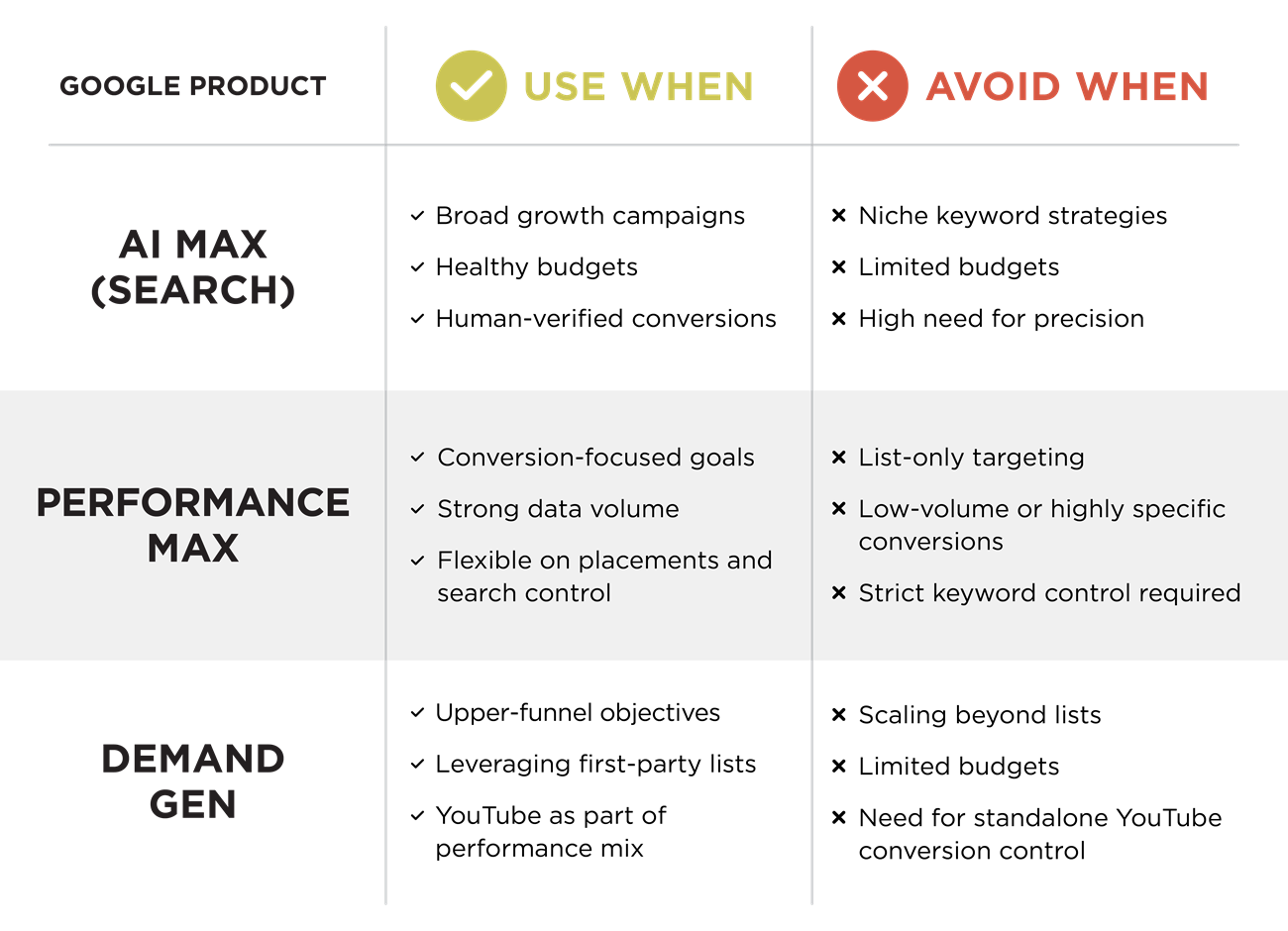
To simplify how these tools compare at a strategic level, here’s a quick-reference summary:
Final Takeaways
Google is clearly leaning into AI-first advertising, not just in creative generation, but in how campaigns are structured, how search works, and how performance is optimized. For media planners and marketing leaders, this shift affects more than campaign setup. It influences how budgets scale, how much control you retain, and how much data is required for success. AI is not just about adopting new tools; it’s about rethinking strategy.
Our testing shows these tools can drive meaningful gains, but only when aligned with the right objectives, budgets, and conversion signals. As we continue evaluating each Google product, our approach remains consistent: stay curious, test strategically, and apply guardrails where needed. AI can be a powerful lever, but strategy still drives performance.


